
Isnin, Oktober 18, 2010
Selasa, Oktober 12, 2010
Konvensyen Anugerah Remaja Perdana Rakan Muda
Konvensyen Anugerah Remaja Perdana Rakan Muda anjuran Kerajaan Negeri Johor akan diadakan di Ruang Pameran Kompleks Islam Johor pada 30 Oktober 2010.
SMK Bandar Tenggara menerima surat jemputan bagi mempromosikan sekolah dan produk yang memenuhi kriteria Anugerah Remaja Perdana Rakan Muda.
Sehubungan dengan itu Kertas Konsep Pameran disediakan bagi dibentangkan dalam mesyuarat pelaksanaan program pada hari Jumaat ini.
1. Komponen : Rekreasi Fizikal
2. Gaya Hidup : Rakan Muda Kecergasan
3. Aktiviti : Sukan Polo Basikal


SMK Bandar Tenggara menerima surat jemputan bagi mempromosikan sekolah dan produk yang memenuhi kriteria Anugerah Remaja Perdana Rakan Muda.
Sehubungan dengan itu Kertas Konsep Pameran disediakan bagi dibentangkan dalam mesyuarat pelaksanaan program pada hari Jumaat ini.
1. Komponen : Rekreasi Fizikal
2. Gaya Hidup : Rakan Muda Kecergasan
3. Aktiviti : Sukan Polo Basikal


Kertas Konsep Pameran.
Ada 3 muka surat.
Ada 3 muka surat.


Khamis, Oktober 07, 2010
CYCLING ASIA MEGAZINE - Cyclepolo

Aidil dan Fuad.
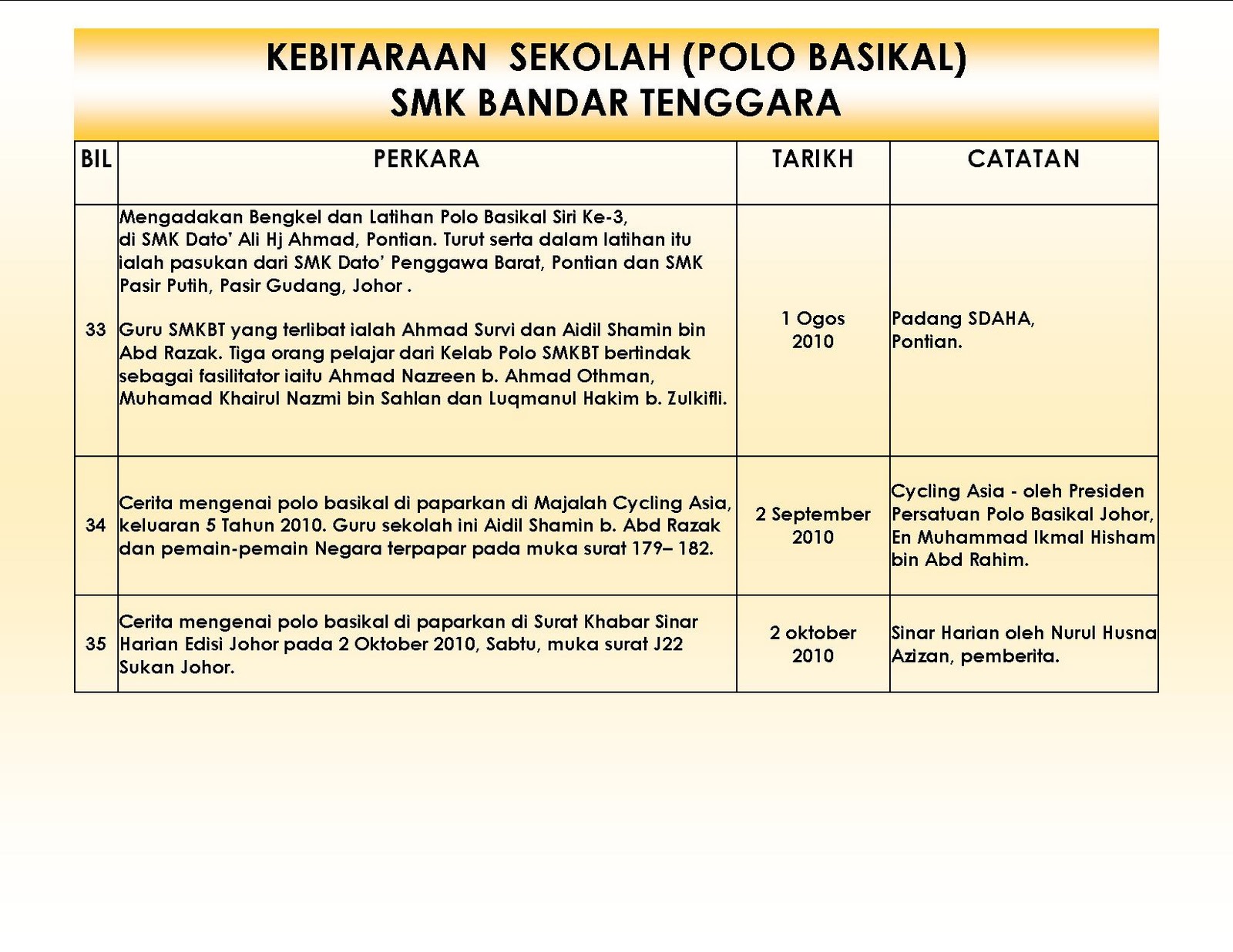
Cycling Asia Megazine, Issue 5 2010.

Cikgu Aidil Shamin Abd Razak (Malaysia Player),
SMK Bandar Tenggara school teacher.

SIMPLE BUT FUN


Malaysia Team.
Muhamad Ikhmal Hisham b. Abd Rahim (Presiden), Nur Hazamimah bte Abdul Aziz (Secretary), Tn Hj Azman b. Mohd Sham (Umpire), Ahmad b. Survi (Umpire), Abd Hadi (Coarch), Ismail, Nazrim, Fuad, Shahrudin, Aidil Shamin, Razali, Mohd Razi, Anuar and Fazlie.
Sabtu, Oktober 02, 2010
Surat Khabar Sinar Harian - SMK Bandar Tenggara terajui polo berbasikal
Kulaijaya, Johor Darul Ta'zim, Malaysia- oleh Nurul Husna Azizan

Kronologi : Kelab Polo Basikal SMKBT
Dari Tahun : 2004 hingga sekarang...


Terima kasih kerana anda mengunjungi Laman Blog kami.
Majulah Sukan Untuk Negara.

Kronologi : Kelab Polo Basikal SMKBT
Dari Tahun : 2004 hingga sekarang...


Terima kasih kerana anda mengunjungi Laman Blog kami.
Majulah Sukan Untuk Negara.

Isnin, September 13, 2010
Bengkel dan Latihan Polo Basikal Ke- Kelantan
Perancangan awal Sukan Polo Basikal untuk ke Kelantan adalah hasil usahasama Pusat Kokurikulum Kelantan dengan Persatuan Polo Basikal Johor, Unit Sukan Jabatan Pelajaran Negeri Johor serta Jabatan Belia dan Sukan Johor.
Pemplate Cadangan:
Pemplate Cadangan:
Bengkel dan Latihan Polo Basikal di SMK Dato' Ahmad Mahir, Bachok Kelantan.
Tarikh : 1, 2 dan 3 Oktober 2010 ditunda ke tarikh baru iaitu
pada 23, 24 dan 25 Oktober 2010 (info dari GPK Kokurikulum, SMK Dato' Ahmad Mahir, Bachok Kelantan).

Muka Surat 1

Muka surat 2
Semoga program yang dirancang ini akan dapat dijalankan dengan jayanya serta mencapai matlamat dan objektifnya. Segala kerjasama daripada semua pihak amat-amat dialu-alukan.
Tentatif Program


Borang di atas boleh diperbanyakkan mengikut bilangan peserta bengkel.
Mint dikemaskinikan dan dihantar semula ke email : ahmadsurvi@gmail.com
atau no faks SMK Bandar Tenggara : 07-8964452, Tel Sekolah : 07-8961037
Di bawah Program Anugerah Remaja Perdana Rakan Muda (ARPRM) anjuran bersama Kemententerian Pelajaran Malaysia dan Kementerian Belia dan Sukan, pelajar yang terlibat akan mencatat segala aktiviti yang disertainya di bawah Komponen Rekreasi Fizikal di dalami Buku Diari Gangsa.
Catatan dalam buku ini akan disahkan oleh GPK Kokurikulum, guru penasihat, jurulatih atau fasilitator yang berkaitan, selepas sesi taklimat, ceramah, penerangan, latihan atau pertandingan.
Catatan sepanjang tahun 2010.
Bermula bulan Februari 2010 hingga Oktober 2010 ialah seperti berikut:-


ms 3
Untuk maklumat lanjut sila hubungi :-
AHMAD BIN SURVI 013-7780699 (SMK Bandar Tenggara,
merangkap Naib Presiden Persatuan Polo BAsikal Johor) dan
HAYATI BINTI ABD HALIM 019-9939949
(Pusat Kokurikulum Kelantan)
Tentatif Program

Bidang Tugas Kepegawaian Pertandingan


Borang di atas boleh diperbanyakkan mengikut bilangan peserta bengkel.
Mint dikemaskinikan dan dihantar semula ke email : ahmadsurvi@gmail.com
atau no faks SMK Bandar Tenggara : 07-8964452, Tel Sekolah : 07-8961037
Di bawah Program Anugerah Remaja Perdana Rakan Muda (ARPRM) anjuran bersama Kemententerian Pelajaran Malaysia dan Kementerian Belia dan Sukan, pelajar yang terlibat akan mencatat segala aktiviti yang disertainya di bawah Komponen Rekreasi Fizikal di dalami Buku Diari Gangsa.
Catatan dalam buku ini akan disahkan oleh GPK Kokurikulum, guru penasihat, jurulatih atau fasilitator yang berkaitan, selepas sesi taklimat, ceramah, penerangan, latihan atau pertandingan.
Catatan sepanjang tahun 2010.
Bermula bulan Februari 2010 hingga Oktober 2010 ialah seperti berikut:-

ms 1

ms 2

ms 3
Untuk maklumat lanjut sila hubungi :-
AHMAD BIN SURVI 013-7780699 (SMK Bandar Tenggara,
merangkap Naib Presiden Persatuan Polo BAsikal Johor) dan
HAYATI BINTI ABD HALIM 019-9939949
(Pusat Kokurikulum Kelantan)
Ahad, Ogos 29, 2010
Cerita Sukan Cyclepolo dengan Cycleball

Gelanggang berturap.
Klik di sini
Polo Basikal adalah sukan berbasikal yang dimainkan secara berpasukan. Sukan ini telah ditemui di Daerah Wicklow, Ireland, pada 1891 oleh Richard J. Mecredy. Beliau adalah atlit berbasikal dan telah bersara. Polo Basikal adalah inovasi daripada sukan Polo Kuda.
Di Negara Eropah sukan Polo Basikal ini menggunakan padang yang berturap, di taman-taman bunga dan kawasan tempat letak kereta. Keadaan ini telah menjadikan sukan ini berkembang dengan luasnya pada tahun 2007.
Sukan ini telah berkembang dengan pesat di Amerika Syarikat, Ireland, Perancis, India, Jerman, Pakistan, Malaysia, Sri Lanka, Indonesia, Hungary, Australia, Sweden, United Kingdom, Argentina, Itali, dan Kanada.
Basikal Bola (Cycleball)

"Cycleball" dimainkan di dalam dewan.
Basikal Bola ini juga dikenali sebagai "radball". Diperkenalkan pada tahun 1893 di Jerman oleh seorang kacukan berbangsa Jerman – Amerika yang dipanggil Nicholas Kaufmann. Sukan ini mirip kepada sukan bola sepak atau futsal. Pemain menggunakan roda basikal untuk mengues, menggelecek, menendang dan menjaringkan gol. Setiap pasukan terdiri daripada dua orang. Basikal yang digunakan tidak ada sistem gear, brek atau freewheel.
Kejohanan Pertama Dunia telah diadakan pada tahun 1929. Sekarang ini bola basikal ini telah dipopularkan di negara-negara seperti Belgium, Republik Czech, Denmark, Perancis, Jerman, Itali, Jepun, Russia, Sweden, dan Switzerland. Pospisil Czechoslovakia telah menjadi juara dunia sebanyak 20 kali antara tahun 1965 dan 1988.
Sebanyak 440 Kelab Sukan Bola Basikal telah tumbuh di bandar-bandar di merata tempat di dunia. Iaitu 314 buah kelab di Jerman, 45 di Switzerland, 19 di Austria, 17 di Jepun, 16 di Perancis, 12 di Republik Czech, 5 di Belgium, 4 di Hungary, 2 di China, 1 di Croatia, 1 di Denmark, 1 di Malaysia (Johor), 1 di Belanda, 1 di Romania dan 1 di Slovakia.
Dikarang oleh abs, 29 Ogos 2010.
Ahad, Ogos 22, 2010
Cerita Mengenai Sukan Polo
Polo Gajah, Kuda Dan Polo Polo Basikal, ada peminatnya masing-masing. Mari kita lihat Sukan Polo Gajah. Bagaimana dan di mana sukan ini dipopularkan?.
 Sukan Polo Gajah adalah satu lagi variasi dari sukan Polo Berkuda. Sukan ini boleh sangat popular beberapa buah negara iaitu Nepal, Sri Lanka, Rajasthan (India) dan Thailand.
Pemain Sukan Polo Bergajah akan menaiki gajah dengan seorang pembantu. pembantu ini dikenali sebagai pawang. Tugas pawang mengendalikan pergerakan gajah. Sementara pemain mengarahkan bola dan membuat jaringan gol.

Sementara Polo Kuda pula menunggang kuda ketika bermain. Lapangan padang berumput sukan Polo Kuda ini adalah amat luas untuk memudahkan pergerakan kuda yang laju dan pantas. Panjang padang adalah 300 meter.Setiap pasukan terdiri daripada empat penunggang kuda . Bola yang digunakan adalah dari jenis plastik atau bola yang diperbuat daripada kayu.
Kunjungi Laman Web di Malaysia
Royal Selangor Polo Club
Singapore

Pemain Sukan Polo Bergajah akan menaiki gajah dengan seorang pembantu. pembantu ini dikenali sebagai pawang. Tugas pawang mengendalikan pergerakan gajah. Sementara pemain mengarahkan bola dan membuat jaringan gol.

Sementara Polo Kuda pula menunggang kuda ketika bermain. Lapangan padang berumput sukan Polo Kuda ini adalah amat luas untuk memudahkan pergerakan kuda yang laju dan pantas. Panjang padang adalah 300 meter.Setiap pasukan terdiri daripada empat penunggang kuda . Bola yang digunakan adalah dari jenis plastik atau bola yang diperbuat daripada kayu.
Kunjungi Laman Web di Malaysia
Royal Selangor Polo Club
Singapore
Khamis, Ogos 19, 2010
Perlembagaan Persatuan - Penubuhan Kelab Polo Basikal Sekolah

ARTIKEL SATU
PERATUAN-PERATURAN DAN UNDANG-UNDANG (PERLEMBAGAAN)BAGI KELAB POLO BASIKAL SEKOLAH MENENGAH KEBANGSAAN BANDAR TENGGARA.
1.1 Nama:
Kelab ini dikenali dengan nama Kelab Polo Basikal Sekolah Menengah Kebangsaan Bandar Tenggara atau ringkasnya KPBSMKBT yang selepas ini disebut sebagai kelab sahaja.
1.2 Alamat:
Kelab Kelab Polo Basikal Sekolah Menengah Kebangsaan Bandar Tenggara, 81440 Bandar Tenggara Johor.
ARTIKEL DUA
2.1 Pendaftar:
Pendaftar kelab ini ialah Pengetua Sekolah Menengah Kebangsaan Bandar Tenggara, 81440 Bandar Tenggara Johor. mengikut Peraturan 4 dan 5 dalam Peraturan-Peraturan Pendidikan (Persatuan Sekolah) 1998 seperti dalam Warta Kerajaan Malaysia Jil.42, No. 11, Tambahan No. 21, Perundangan (A): P.U.(A) 196 bertarikh 21 Mei 1998.
2.2 No. Pendaftaran:
28/2004/SMK Bandar Tenggara.
2.3 Dokumen Pendaftaran:
Bil: (23) dlm. SMKBT 03/03/02 bertarikh 4 Oktober 2004.
ARTIKEL TIGA
3.1 Penasihat:
Penasihat kelab ini dilantik oleh Pengetua Sekolah Menengah Kebangsaan Bandar Tenggara mengikut Peraturan 8 dalam Peraturan-Peraturan Pendidikan (Persatuan Sekolah) 1998 seperti dalam Warta Kerajaan Jil. 42, No. 11, Tambahan No. 21, Perundangan (A): P.U.(A) 196 bertarikh 21 Mei 1998.
4. Tujuan:-
Kelab ini ditubuhkan dengan tujuan untuk:-
4.1 Mengumpulkan pelajar-pelajar yang berminat dengan permainan Polo Basikal.
4.2 Memupuk kemesraan, semangat sepasukan dan bersatu padu di kalangan ahli-ahli kelab.
4.3 Menyemarakkan kegiatan-kegiatan kependidikan yang berkaitan dengan bidang permainan polo basikal.
4.4 Mewujudkan peluang kepada ahli-ahli kelab mengembangkan bakat dan potensi masing-masing dalam bidang permainan Polo Basikal.
4.5 Meningkatkan pengetahan, pengalaman, dan kemahiran ahli-ahli dalam permainan Polo Basikal.
ARTIKEL LIMA
5.1 Keahlian:5.1.1 Syarat-syarat keahlian:-
5.1.1.1 Keahlian adalah terbuka kepada semua pelajar Sekolah Menengah Kebangsaan Bandar Tenggara.
5.1.1.2 Permohonan untuk menjadi ahli boleh dibuat menggunakan Borang Permohonan Menjadi Ahli (Borang PMA) dan dikemukakan kepada Setiausaha tidak lewat daripada 31 Januari setiap tahun.
5.1.1.3 Kelulusan permohonan menjadi ahli akan dipertimbang dan diluluskan oleh Jawatankuasa. Keputusan Jawatankuasa menerima atau menolak sesuatu permohonan adalah muktamad.
5.1.1.4 Setiap permohonan untuk menjadi ahli hendaklah atas kerelaan sendiri tanpa dipaksa atau dipengaruhi oleh mana¬mana pihak dan mendapat persetujuan daripada ibu bapa atau penjaga masing-masing.
5.1.2 Hak ahli:
Seseorang yang telah disahkan keahliannya berhak untuk:-
5.1.2.1 mengundi dalam pemilihan Ahli Jawatankuasa kelab;
5.1.2.2 menjadi calon dalam pemilihan Ahli Jawatankuasa kelab;
5.1.2.3 menghadiri dan menyertai aktiviti-aktiviti kelab;
5.1.2.4 menggunakan peralatan, prasarana, dan kemudahan-kemudahan kepunyaan kelab;
5.1.2.5 mengemukakan cadangan, aduan, idea dan pendapat kepada Ahli Jawatankuasa Kelab mengenai isu-isu yang berbangkit.
5.1.3 Kewajipan Ahli:
Seseorang pelajar yang telah disahkan menjadi ahli kelab ini wajib:-
5.1.3.1 Menghormati, mendukung, dan mematuhi Perlembagaan dan Peraturan- Peraturan Kelab ini sepanjang masa dan dalam semua keadaan;
5.1.3.2 Mematuhi, menghormati dan melaksanakan semua keputusan yang dibuat oleh Jawatankuasa Kelab;
5.1.3.3 Menjaga dan mempertahankan nama baik, maruah dan identiti kelab;
5.1.3.4 Memelihara dan menjaga harta benda kelab;
5.1.3.5 Tidak menyebarkan kepada sesiapa sahaja rahsia-rahsia kelab;
5.1.3.6 Tidak mementingkan diri sendiri sebaliknya sentiasa bekerjasama dan bermuafakat dengan ahli-ahli lain;
5.1.3.7 Tidak mengkhianati sebarang usaha atau program-program yang dianjurkan oleh kelab;
5.1.3.8 Menjelaskan derma keahlian sebelum 31 Januari setiap tahun.
5.1.4 Pemberhentian dan Pemecatan Ahli.
5.1.4.1 Ahli yang hendak berhenti daripada menjadi ahli kelab hendaklah menyerahkan permohonan bertulis sebulan terlebih dahulu kepada Setiausaha. Permohonan untuk berhenti daripada menjadi ahli akan diluluskan oleh Jawatankuasa Kelab atas nasihat Guru Penasihat.
5.1.4.2 Mana-mana ahli yang gagal mematuhi undang-undang dan peraturan- peraturan kelab atau bertindak dengan cara yang akan mencemarkan nama baik kelab boleh dipecat atau digantung keahliannya bagi suatu tempoh sebagaimana yang difikirkan munasabah oleh Jawatankuasa Kelab atas nasihat Guru Penasihat. Sebelum Jawatankuasa Kelab memecat atau menggantung ahli tersebut, ahli itu hendaklah diberitahu akan sebab-sebab bagi pemecatan atau penggantungannya secara bertulis. Ahli tersebutjuga hendaklah diberi peluang untuk memberikan penjelasan dan membela dirinya. Pemecatan dan penggantungan itu hendaklah dilaksanakan melainkan mesyuarat agung menunda atau membatalkan keputusan atas rayuan oleh ahli tersebut.
Selasa, Ogos 17, 2010
PENALTIES (page 13)
10. Players Warned Excluded
The umpire will carry yellow and red cards. In case of deliberate and/or dangerous foul or conduct of a player prejudicial to the game the Umpire will show yellow card (Warning Card) and will note his name, number of number of chukkar.
On repeating same or other serious offence he will be shown red card (Exclusion card), which will automatically exclude the player from the game.
The side to which excluded player belonged shall continue with three player to play or it may forfeit the match. However when the chukkar is over, the umpires may allow the same player to play or will allow the 5th player to substitute him for the rest of the match, or at his discretion will make the team to play with three players for the rest of the match or as long as Umpires desires .
Player punished under Penalty No. 10 cannot be substituted without permission of Umpires.
Note: The circumstances which caused this penalty (red card only) to be inflicted will be reported by the umpire in writing to the committee conducting the tournament to enable them to judge whether the case should be reported to higher authorities.
This should be borne in mind that the Penalty No. 10 is in addition to any other penalty given by the umpire for the offence committed.
The umpire will carry yellow and red cards. In case of deliberate and/or dangerous foul or conduct of a player prejudicial to the game the Umpire will show yellow card (Warning Card) and will note his name, number of number of chukkar.
On repeating same or other serious offence he will be shown red card (Exclusion card), which will automatically exclude the player from the game.
The side to which excluded player belonged shall continue with three player to play or it may forfeit the match. However when the chukkar is over, the umpires may allow the same player to play or will allow the 5th player to substitute him for the rest of the match, or at his discretion will make the team to play with three players for the rest of the match or as long as Umpires desires .
Player punished under Penalty No. 10 cannot be substituted without permission of Umpires.
Note: The circumstances which caused this penalty (red card only) to be inflicted will be reported by the umpire in writing to the committee conducting the tournament to enable them to judge whether the case should be reported to higher authorities.
This should be borne in mind that the Penalty No. 10 is in addition to any other penalty given by the umpire for the offence committed.
pgs 13
PENALTIES (page 12)
4. 45 Meters Hit (Opposite Goal)
A free hit at the ball from a spot 45 meters from the goal line of the fouling side opposite the middle of the goal; none of the fouling side player will remain within 15 meters of the ball, while the players of the side fouled will remain free to place themselves wherever they choose.
5(a). Free Hit From the Spot
A free hit at the ball from where it was at the time of the foul but not nearer than 4 meters from the side lines; none of the fouling side player will remain within 15 meters of the ball, while the players of the side fouled will remain free to place themselves wherever they choose.
5(b). Free Hit from the centre
A free hit at the ball from the centre of the ground. None of the player from the fouling side to be within 15 meters of the ball, while the players of the side fouled will remain free to place themselves wherever they choose.
A free hit at the ball from a spot 45 meters from the goal line of the fouling side opposite the middle of the goal; none of the fouling side player will remain within 15 meters of the ball, while the players of the side fouled will remain free to place themselves wherever they choose.
5(a). Free Hit From the Spot
A free hit at the ball from where it was at the time of the foul but not nearer than 4 meters from the side lines; none of the fouling side player will remain within 15 meters of the ball, while the players of the side fouled will remain free to place themselves wherever they choose.
5(b). Free Hit from the centre
A free hit at the ball from the centre of the ground. None of the player from the fouling side to be within 15 meters of the ball, while the players of the side fouled will remain free to place themselves wherever they choose.
6. 45 Meters Hit (Opposite where the Ball Crossed)
A free hit at the ball from a spot 45 Meters distant opposite from the back line where the ball crossed it, but not nearer than 4 meters from the side lines. None of the players from the fouling side will remain within 15 meters of the ball, while the players of the side fouled will remain free to place themselves wherever they choose.
A free hit at the ball from a spot 45 Meters distant opposite from the back line where the ball crossed it, but not nearer than 4 meters from the side lines. None of the players from the fouling side will remain within 15 meters of the ball, while the players of the side fouled will remain free to place themselves wherever they choose.
7. Another Hit (Penalty 2, 3, 4, 5 or 6)
If the fouling side fails to carry out Penalty 2, 3, 4, 5 or 6 correctly the side fouled shall be allowed another free hit at the ball unless a goal has been scored or awarded. If both sides fail to carry out Penalty 2 or 3 correctly another free hit will be allowed by the side fouled, irrespective of the result of the previous free hit.
8. Player to retire
The captain of the side fouled will designate one such player on the fouling side whose handicap is nearest above to the disabled player, who retires from the game. If the handicap of the disabled player is higher than that of any of his opponents, the player whose handicap is nearest below of the disabled player will be designated. If there are two or more such players, the captain of the side fouled will designate one to retire. The game shall remain continued with three players on each side and if the fouling side refuses to continue the game, it shall thereby forfeit the match. This penalty does not apply to international matches.
If the fouling side fails to carry out Penalty 2, 3, 4, 5 or 6 correctly the side fouled shall be allowed another free hit at the ball unless a goal has been scored or awarded. If both sides fail to carry out Penalty 2 or 3 correctly another free hit will be allowed by the side fouled, irrespective of the result of the previous free hit.
8. Player to retire
The captain of the side fouled will designate one such player on the fouling side whose handicap is nearest above to the disabled player, who retires from the game. If the handicap of the disabled player is higher than that of any of his opponents, the player whose handicap is nearest below of the disabled player will be designated. If there are two or more such players, the captain of the side fouled will designate one to retire. The game shall remain continued with three players on each side and if the fouling side refuses to continue the game, it shall thereby forfeit the match. This penalty does not apply to international matches.
9. Bicycle Ordered Off
In case of infringement of Field Rule 3, a bicycle will be ordered off the ground by the Umpire and will remain disqualified from playing again till the offence has been removed.
In case of infringement of Field Rule 3, a bicycle will be ordered off the ground by the Umpire and will remain disqualified from playing again till the offence has been removed.
PENALTIES (page 11)
PENALTIES
1. Penalty Goal
(a) If, in the opinion of the Umpire, a player in order to avoid a goal, commits a dangerous or deliberate foul in the vicinity of goal, the side fouled shall be given a goal. (b) The game shall re-start at spot 10 yards away from the middle of the fouling team's goal in the manner prescribed in Field Rule 25. Ends shall not be changed.
2. 15 Meters Hit
(a) A free hit at the ball from a spot 15 meters from the goal line of fouling side opposite the middle of the goal, or if preferred, from where the foul occurred ( the choice to rest with the captain of the side fouled). All the players of the fouling side to remain behind their back line until the ball is hit, or hit at, but not between the goal posts. Nor any of the side will ride out from between the goal posts when the ball is brought into play.
None of the players of the fouled side will be nearer the goal line or back line than the ball at the moment it is hit or hit at. In case the captain chooses to take the penalty from the spot where the foul occurred, none of the defending side players will remain within 15 meters of the ball nor come out from between the goal posts.
(b) In carrying out Penalty 2 if the free hit would, in the opinion of the Umpire, have resulted in a goal but is stopped by one of the fouling side player coming from between the goal posts or crossing the back line before the ball was struck, such shot will count as a goal to the side fouled. If the player who stopped the ball did not infringe these rules, but another player of the side did, Penalty 7 shall be exacted.
3. 25 Meters Hit
(a) A free hit at the ball from a spot 25 meters from the goal line of fouling side opposite the middle of the goal; all the fouling side players to remain behind their back line until the ball is hit, or hit at, but not between the goal posts. Nor any of the side will ride out from between the goal posts when the ball is brought into play. None of the players of the fouled side will be nearer the goal line or back line than the ball at the moment it is hit or hit at.
(b) In carrying out Penalty 3 if the free hit would, in the opinion of the Umpire, have resulted in a goal but is stopped by one of the fouling side player coming from between the goal posts or crossing the back line before the ball was struck, such shot will count as a goal to the side fouled. If the player who stopped the ball did not infringe these rules, but another player of his side did, Penalty 7 shall be exacted.
4. 45 Meters Hit (Opposite Goal)
A free hit at the ball from a spot 45 meters from the goal line of the fouling side opposite the middle of the goal; none of the fouling side player will remain within 15 meters of the ball, while the players of the side fouled will remain free to place themselves wherever they choose.
5(a). Free Hit From the Spot
A free hit at the ball from where it was at the time of the foul but not nearer than 4 meters from the side lines; none of the fouling side player will remain within 15 meters of the ball, while the players of the side fouled will remain free to place themselves wherever they choose.
5(b). Free Hit from the centre
A free hit at the ball from the centre of the ground. None of the player from the fouling side to be within 15 meters of the ball, while the players of the side fouled will remain free to place themselves wherever they choose.
A free hit at the ball from a spot 45 meters from the goal line of the fouling side opposite the middle of the goal; none of the fouling side player will remain within 15 meters of the ball, while the players of the side fouled will remain free to place themselves wherever they choose.
5(a). Free Hit From the Spot
A free hit at the ball from where it was at the time of the foul but not nearer than 4 meters from the side lines; none of the fouling side player will remain within 15 meters of the ball, while the players of the side fouled will remain free to place themselves wherever they choose.
5(b). Free Hit from the centre
A free hit at the ball from the centre of the ground. None of the player from the fouling side to be within 15 meters of the ball, while the players of the side fouled will remain free to place themselves wherever they choose.
pgs 11
Field Rules (page 10)
27. Blocking of way
No player will block the other players by riding along with him, thereby not permitting him to go towards the ball or enter in the game, whether the player has Right of Way or otherwise.
28. Discretion of Umpires
(a) Should any incident or question not provided for in the rules of Cycle Polo arise in a match such incident or question shall be decided by the Umpire or Umpires. If the Umpires disagree, the Referee's decision shall be final.
(b) There are degrees of dangerous play and unfair play which give an advantage to the side fouling. The Penalty to be inflicted is left to the discretion of the Umpire or Umpires and shall only be referred to the Referee in the event of the Umpires disagreeing on the penalty.
No player will block the other players by riding along with him, thereby not permitting him to go towards the ball or enter in the game, whether the player has Right of Way or otherwise.
28. Discretion of Umpires
(a) Should any incident or question not provided for in the rules of Cycle Polo arise in a match such incident or question shall be decided by the Umpire or Umpires. If the Umpires disagree, the Referee's decision shall be final.
(b) There are degrees of dangerous play and unfair play which give an advantage to the side fouling. The Penalty to be inflicted is left to the discretion of the Umpire or Umpires and shall only be referred to the Referee in the event of the Umpires disagreeing on the penalty.
Field Rules (page 9)
20. Dismounted Player
No dismounted player or a player with one or both feet touching the ground shall interfere with the game. He may however, continue with the game as soon as he has removed the above disqualification. This rule applies to the area within the safety zone.
21. Accident or Injury
(a) If a player falls off his bicycle the Umpire shall not stop the game, unless he is of the opinion that the player is injured. What constitutes a fall will be left to the decision of the Umpire.
(b) When the game has been stopped in accordance with clause (a) above the Umpire shall restart the game in the manner laid down in Field Rule 25, as soon as the player concerned is ready to resume play. The Umpire shall not wait for any other player who may not be present.
(b) When the game has been stopped in accordance with clause (a) above the Umpire shall restart the game in the manner laid down in Field Rule 25, as soon as the player concerned is ready to resume play. The Umpire shall not wait for any other player who may not be present.
22. Unable to Play Due to injury
If a player be injured, a period not exceeding 10 minutes shall be allowed for his recovery. If the injured player is unable to play after 10 minutes, the game shall restart with a substitute in place of the injured player provided Penalty 8 has not been exacted. If, however, the injured player subsequently recovers he may replace the player who substituted but the handicap of the higher handicapped player will be counted in accordance with General Rule 4 (c).
23. Disablement
If a player be disabled by a foul so that he is unable to continue, Penalty 8 will be exacted or the side which has been fouled shall have the option of providing a substitute. Penalty 1, 2 or 3 as the case may be, shall be exacted in any case. The umpire may award Penalty No. 10.
24. When game is not stopped
It shall be within the discretion of the Umpire not to stop the game for the purpose of inflicting a penalty if the stopping of the game and the infliction of the Penalty would be disadvantageous to the fouled side.
25. Re-starting when Ball was not out
If for any reason the game is stopped without the ball going out of play it shall restart in the following manner. The Umpire shall stand at the spot, where the ball was when the incident occurred , facing the nearer side of the ground, but not less than 20 meters near the side lines. Both teams shall take up their positions each being on its own side of an imaginary line, parallel to the goal lines and extending through the Umpire to the sides of the ground. No player will stand within 5 meters of the Umpire. The Umpire shall bowl the ball, underhand and hard between the opposition ranks of players towards the nearer side of the ground, the players remaining stationary until the ball has left his hand. until the umpire says PLAY or indicates the players to come towards him.
26. Consecutive Three Time Touch
No player shall touch the ball with his stick or right hand up to the elbow more than 3 times consecutively. He can touch again for three times only after the ball touches another player's stick or bicycle. NOTE: A player by virtue of his having touched the ball three times consecutively will lose his Right of Way. He has to give way to other players coming from any direction to tackle the ball or establish the Right of Way (Provided sufficient time has been given to him to pull-up or pull away). He may, however, hook the stick of the opponent if he happens to be on the same side of the ball immediately after the third touch. But he will not follow the line of the ball to hook the stick of the opponent, thereby blocking or in any way coming in the way of other players to take the ball.
Field Rules (page 8)
15. Crossing the Right of Way
The Line of the Ball:
(b) (iii) When a dead ball will be put into play through being hit at and missed, the line of he ball is considered to be the direction in which the player was riding when he hit at it.
(b) (iv) If the ball becomes stationary while remaining in play the line of the ball will be that line upon which it was travelling before stopping.
Player Riding in Direction the Ball is Travelling
(c) (i) A player following the ball on its exact line and taking it on his off side, will be entitled to the Right of Way over all other players, subject to clause (c)(iii).
(c) (ii) Where no player will be riding on the exact line of the ball the Right of Way will belong to the player following it on the smallest angle, provided he does not contravene Clause (f).
(c) (iii) Two players when following the exact line of the ball will share the Right of Way over all other players.
(c) (iv) A player riding in the direction the ball will be travelling at an angle to its line, will have the Right of Way over a player riding to meet the ball at an angle to its line, irrespective of the width of the angle provided he does not contravene Clause (f).
(c) (v) No player shall be deemed to have the Right of Way by reason of his being the last striker of the ball if he shall deviate from pursuing the exact line of the ball.
Equal Angles
(d) In the rare case of two players riding in the general direction of the ball at exactly equal angles to it on opposite sides of its line, each player must remain on his respective side of the Line. The same rule will apply to players meeting the ball at exactly equal angles from opposite sides of the line.
Player Meeting the Ball
(e) (i) A player who rides to meet the ball on its exact line shall have the Right of Way over all players riding at an angle from any direction.
(e) (ii) Among the players riding to meet the ball, the player whose course will be at the least angle to the line of the ball will have the Right of Way.
Player to Take Ball on Off-side
(f) (i) The Right of Way will entitle a player to take the ball on the off side of his Cycle. If he places himself to hit on the near side and thereby in any way endangers another player who would otherwise have been clear, he will lose the Right of Way and will give way to the other player.
(f) (ii) When two players are riding from exactly opposite directions to hit the ball, each shall take it on the off side of his Cycle.
(b) (iii) When a dead ball will be put into play through being hit at and missed, the line of he ball is considered to be the direction in which the player was riding when he hit at it.
(b) (iv) If the ball becomes stationary while remaining in play the line of the ball will be that line upon which it was travelling before stopping.
Player Riding in Direction the Ball is Travelling
(c) (i) A player following the ball on its exact line and taking it on his off side, will be entitled to the Right of Way over all other players, subject to clause (c)(iii).
(c) (ii) Where no player will be riding on the exact line of the ball the Right of Way will belong to the player following it on the smallest angle, provided he does not contravene Clause (f).
(c) (iii) Two players when following the exact line of the ball will share the Right of Way over all other players.
(c) (iv) A player riding in the direction the ball will be travelling at an angle to its line, will have the Right of Way over a player riding to meet the ball at an angle to its line, irrespective of the width of the angle provided he does not contravene Clause (f).
(c) (v) No player shall be deemed to have the Right of Way by reason of his being the last striker of the ball if he shall deviate from pursuing the exact line of the ball.
Equal Angles
(d) In the rare case of two players riding in the general direction of the ball at exactly equal angles to it on opposite sides of its line, each player must remain on his respective side of the Line. The same rule will apply to players meeting the ball at exactly equal angles from opposite sides of the line.
Player Meeting the Ball
(e) (i) A player who rides to meet the ball on its exact line shall have the Right of Way over all players riding at an angle from any direction.
(e) (ii) Among the players riding to meet the ball, the player whose course will be at the least angle to the line of the ball will have the Right of Way.
Player to Take Ball on Off-side
(f) (i) The Right of Way will entitle a player to take the ball on the off side of his Cycle. If he places himself to hit on the near side and thereby in any way endangers another player who would otherwise have been clear, he will lose the Right of Way and will give way to the other player.
(f) (ii) When two players are riding from exactly opposite directions to hit the ball, each shall take it on the off side of his Cycle.
Field Rules (page 7)
15. Crossing the Right of Way
The Line of the Ball:
(b) (iii) When a dead ball will be put into play through being hit at and missed, the line of he ball is considered to be the direction in which the player was riding when he hit at it.
(b) (iv) If the ball becomes stationary while remaining in play the line of the ball will be that line upon which it was travelling before stopping.
Player Riding in Direction the Ball is Travelling
(c) (i) A player following the ball on its exact line and taking it on his off side, will be entitled to the Right of Way over all other players, subject to clause (c)(iii).
(c) (ii) Where no player will be riding on the exact line of the ball the Right of Way will belong to the player following it on the smallest angle, provided he does not contravene Clause (f).
(c) (iii) Two players when following the exact line of the ball will share the Right of Way over all other players.
(c) (iv) A player riding in the direction the ball will be travelling at an angle to its line, will have the Right of Way over a player riding to meet the ball at an angle to its line, irrespective of the width of the angle provided he does not contravene Clause (f).
(c) (v) No player shall be deemed to have the Right of Way by reason of his being the last striker of the ball if he shall deviate from pursuing the exact line of the ball.
Equal Angles
(d) In the rare case of two players riding in the general direction of the ball at exactly equal angles to it on opposite sides of its line, each player must remain on his respective side of the Line. The same rule will apply to players meeting the ball at exactly equal angles from opposite sides of the line.
Player Meeting the Ball
(e) (i) A player who rides to meet the ball on its exact line shall have the Right of Way over all players riding at an angle from any direction.
(e) (ii) Among the players riding to meet the ball, the player whose course will be at the least angle to the line of the ball will have the Right of Way.
Player to Take Ball on Off-side
(f) (i) The Right of Way will entitle a player to take the ball on the off side of his Cycle. If he places himself to hit on the near side and thereby in any way endangers another player who would otherwise have been clear, he will lose the Right of Way and will give way to the other player.
(f) (ii) When two players are riding from exactly opposite directions to hit the ball, each shall take it on the off side of his Cycle.
(b) (iii) When a dead ball will be put into play through being hit at and missed, the line of he ball is considered to be the direction in which the player was riding when he hit at it.
(b) (iv) If the ball becomes stationary while remaining in play the line of the ball will be that line upon which it was travelling before stopping.
Player Riding in Direction the Ball is Travelling
(c) (i) A player following the ball on its exact line and taking it on his off side, will be entitled to the Right of Way over all other players, subject to clause (c)(iii).
(c) (ii) Where no player will be riding on the exact line of the ball the Right of Way will belong to the player following it on the smallest angle, provided he does not contravene Clause (f).
(c) (iii) Two players when following the exact line of the ball will share the Right of Way over all other players.
(c) (iv) A player riding in the direction the ball will be travelling at an angle to its line, will have the Right of Way over a player riding to meet the ball at an angle to its line, irrespective of the width of the angle provided he does not contravene Clause (f).
(c) (v) No player shall be deemed to have the Right of Way by reason of his being the last striker of the ball if he shall deviate from pursuing the exact line of the ball.
Equal Angles
(d) In the rare case of two players riding in the general direction of the ball at exactly equal angles to it on opposite sides of its line, each player must remain on his respective side of the Line. The same rule will apply to players meeting the ball at exactly equal angles from opposite sides of the line.
Player Meeting the Ball
(e) (i) A player who rides to meet the ball on its exact line shall have the Right of Way over all players riding at an angle from any direction.
(e) (ii) Among the players riding to meet the ball, the player whose course will be at the least angle to the line of the ball will have the Right of Way.
Player to Take Ball on Off-side
(f) (i) The Right of Way will entitle a player to take the ball on the off side of his Cycle. If he places himself to hit on the near side and thereby in any way endangers another player who would otherwise have been clear, he will lose the Right of Way and will give way to the other player.
(f) (ii) When two players are riding from exactly opposite directions to hit the ball, each shall take it on the off side of his Cycle.
Field Rules (page 6)
9. Unnecessary Delay
The defenders shall give the attacking side reasonable time to get into position, but there shall be no delay in hitting in. In the event of unnecessary delay the Umpire call on the defending side to hit at once. If the Umpire's request is not complied with, he shall bowl the ball in underhand and hard at the spot where the ball crossed the back line and at right angles to it.
10. Defenders Hit Behind
If the ball be hit behind the back line by any of the defending side's players either directly or after glancing off his own bicycle or stick penalty 6 shall be exacted. If the ball strikes any other player or his bicycle before going behind, it shall be hit in in accordance with Field Rule 8.
11. Ball Hit Out: (Side Line)
(a) The ball will go over and clear the side lines to be out.
(b) When the ball will be hit or is deflected by bicycle, stick or body of a player, over the side lines, a free hit only to be taken by backhand, from the spot from where it went out, will be awarded to the opposite team. No player other than the hitter shall be within 10 meters of the ball when it is hit or hit at.
(b) When the ball will be hit or is deflected by bicycle, stick or body of a player, over the side lines, a free hit only to be taken by backhand, from the spot from where it went out, will be awarded to the opposite team. No player other than the hitter shall be within 10 meters of the ball when it is hit or hit at.
12. Restarting After Interval
On the play being resumed after an interval, the ball shall be put in normal manner which would have been followed, had there been no interval, i.e. in accordance with Field Rules 7, 8, 11 or 25 as the case may be. The Umpire will not wait for the players who remain late.
13. Damaged Ball
If the ball be damaged the Umpire shall, at his discretion stop the game and re-start it with a new ball, in the manner prescribed in Field Rule 25.
14. Carrying the Ball
A Player will not catch, kick or hit the ball with anything but with his stick or right hand up to the elbow. He may block it with any part of his body but not with an open hand. He will not carry the ball intentionally. If the ball becomes lodged against a player, his bicycle, or its spokes in such a way that it cannot be dropped immediately, the Umpire shall blow his whistle and restart the game in accordance with Field Rule 25 at the point where it was first carried.
Field Rules (page 5)
FIELD RULES
1. Definition of Foul
Any infringement of the field rules will constitute a foul, and the Umpire may stop the game.
2. Dead Ball
The Umpire shall carry a whistle, which he shall blow when he wishes to stop the game. When he does so the ball is dead until he says "PLAY", and the time it is dead is not counted in the playing time of the period, except as legislated for in General Rule 12.
Note: If a whistle is blown for a foul approximately at the same time when a goal is scored:
i) The goal will be disallowed if the foul will be against the attacking side and is confirmed.
ii) The goal will be allowed if the foul will be against the attacking side and the foul is overruled, or if the foul will be against the defending side whether or not the foul is confirmed.
Note: If a whistle is blown for a foul approximately at the same time when a goal is scored:
i) The goal will be disallowed if the foul will be against the attacking side and is confirmed.
ii) The goal will be allowed if the foul will be against the attacking side and the foul is overruled, or if the foul will be against the defending side whether or not the foul is confirmed.
3. Disqualified Cycle
A bicycle disqualified as mentioned in the General Rule 1 shall not be allowed in the game.
4. Safety Zone
(a) No person will be allowed to enter the ground during play for any purpose whatsoever, except the players and the umpires. A player requiring a stick, bicycle, or other assistance from an outside person will ride to the side or back lines to procure it. No person will come on the ground to assist a player.
(b) No person will be allowed within the Safety Zone during play except players, umpires, referees, linemen, goal judges, manager or committee members. Note: The Safety Zone is the area consisting of the field of play, 15 meters beyond the goal line and 5 to 8 meters parallel to side lines.
(b) No person will be allowed within the Safety Zone during play except players, umpires, referees, linemen, goal judges, manager or committee members. Note: The Safety Zone is the area consisting of the field of play, 15 meters beyond the goal line and 5 to 8 meters parallel to side lines.
5. Starting of the Game
At the beginning of the game, the two teams shall line up in the middle of the ground, each team being on its own side of the halfway line. the Umpire shall bowl the ball underhand and hard between the opposing ranks of players, from a distance of not less then five meters, the players remaining stationary until the ball has left his hand.
6. How Goal is Scored
A goal is scored when a ball will pass between the goal posts and clears the goal line. If a ball is hit above the top of the goal posts, and in the opinion of the Umpire is between these posts, it shall also count as a goal.
7. Changing of Ends
Ends shall be changed after every goal except where a goal is awarded under Penalty 1. Ends shall also be changed if no goals have been hit by half-time and the play shall re-start in position corresponding to the change of ends. After a goal has been hit, the game shall be re-started from the middle of the ground as prescribed in Field Rule 5. The players shall be allowed a reasonable time to reach the middle of the ground at a slow speed and take up their positions.
8. Attackers hit Behind
(a) The ball will go over and clear of the back line to be out.
(b) When the ball is hit behind the back line by the attacking side, it shall be hit in by the defenders from the spot where it crossed the line, but at least four meters away from the goal posts, when the Umpire says "PLAY". None of the attacking side shall be within 15 meters of the back line until the ball is hit or hit at, the defenders being free to place themselves where they choose.
(b) When the ball is hit behind the back line by the attacking side, it shall be hit in by the defenders from the spot where it crossed the line, but at least four meters away from the goal posts, when the Umpire says "PLAY". None of the attacking side shall be within 15 meters of the back line until the ball is hit or hit at, the defenders being free to place themselves where they choose.
General Rules (page 4)
15. Widened Goals
Any extra-time chukkar necessitated by a tie at the end of the final period of a match will be with widened goals.
16. Rules for Widened Goals
(a) Width of goals to be doubled to 8 meters by moving goal posts 2 meters each outwards.
(b) After the interval of five minutes, ends will be changed and the ball thrown-in from the centre in the first of the extra chukkars.
(b) After the interval of five minutes, ends will be changed and the ball thrown-in from the centre in the first of the extra chukkars.
17. Prolongation in Case of Penalty
In the event of a penalty being awarded to a team which is behind in score within 20 seconds of the end of the match, the Timekeeper shall allow 20 seconds play from the time the ball is hit or hit at, in carrying out the penalty, before he rings the final bell. If a goal is scored after the ball has been put into play, and the original regular time has expired, the final bell shall be rung. The match shall terminate as usual on the first stroke of the final bell.
18. Unfinished Match
Once a match has started it shall be played to a finish unless stopped by the Umpire for some unavoidable cause, such as darkness or weather condition which prevents a finish the same day. In such case it shall be resumed at the point at which it was stopped, as to score, period, and position of the ball, at the earliest convenient time, to be decided upon by the committee conducting the tournament.
19. How Game is won
The side that scores more goals wins the game.
20. Confusing Colours
If in the opinion of the Tournament Committee or Umpires the colours of the two competing teams are so alike as to lead to confusion, the team lower in the draw shall be instructed to play in some other colour.
General Rules (page 3)
8. Handicap Calculation
In all matches played under handicap conditions, the higher handicap team (Sum total of handicaps of four players) shall concede to lower handicap team, as many goals as the difference is, in the four chukkar match. But in the event the tournament committee or the technical committee decides to play the match more than 4 chukkars for each additional chukkar the goals to be conceded will be calculated as follows.
(a) The difference of goals between the two teams will be divided by 4 and the result thereby will be added in the difference of goals for playing additional chukkar.
(b) If there is any fraction, less than half will be counted as half, and fraction more than half will be counted as one. Example 1- If the difference of goals between two teams for 4 chukkar is 7 goals, it will be divided by 4, result will be 1.75 therefore 2 more goal will be added in the difference for one extra chukkar. Example 2- If the difference is 5 goals in the 4 chukkar between two teams, on dividing by 4 the result will be 1.25. This means only one and a half goal should be added in the original difference of goal for one extra chukkar. Similarly in the event of the tournament committee or the technical committee decided to play 3 chukkars match, the result arrived in the above examples will be reduced from the original difference in goals between two teams.
In all matches played under handicap conditions, the higher handicap team (Sum total of handicaps of four players) shall concede to lower handicap team, as many goals as the difference is, in the four chukkar match. But in the event the tournament committee or the technical committee decides to play the match more than 4 chukkars for each additional chukkar the goals to be conceded will be calculated as follows.
(a) The difference of goals between the two teams will be divided by 4 and the result thereby will be added in the difference of goals for playing additional chukkar.
(b) If there is any fraction, less than half will be counted as half, and fraction more than half will be counted as one. Example 1- If the difference of goals between two teams for 4 chukkar is 7 goals, it will be divided by 4, result will be 1.75 therefore 2 more goal will be added in the difference for one extra chukkar. Example 2- If the difference is 5 goals in the 4 chukkar between two teams, on dividing by 4 the result will be 1.25. This means only one and a half goal should be added in the original difference of goal for one extra chukkar. Similarly in the event of the tournament committee or the technical committee decided to play 3 chukkars match, the result arrived in the above examples will be reduced from the original difference in goals between two teams.
9. Play Continuous
With the exception of the above said intervals the play shall remain continuous and no time shall be taken off for changing bicycles and sticks during a period, except as legislated for in the Field Rule 22.
10. Termination of Period (Chukkar)
Each period of play except the last shall terminate after the expiration of the prescribed time (designated by the ringing of a bell or other signal) as soon as the ball goes out of play, or on ringing the second bell on the expiry of 30 seconds and the game will terminate wherever the ball is.
NOTE: In all cases (except the last period when the score is not tied) players shall continue to play until the ringing of the second bell.
NOTE: In all cases (except the last period when the score is not tied) players shall continue to play until the ringing of the second bell.
11. Penalty exacted next period (Chukkar)
If a foul is given at the first stroke of the bell after the Umpire's whistle terminates the period, the penalty shall be exacted at the beginning of the next period, except in the event of a tie in the last period when the penalty shall be exacted at once and the period continued until ringing of the second bell on expiry of 30 seconds and the game will terminate wherever the ball is.
12. Game Stopped
The game shall be stopped in two different ways:
(a) The game shall be stopped whenever the ball is out of play or dead, i.e. when the ball goes through the goal, side or back lines, or when a foul occurs.
(b) The umpire shall blow two sharp blasts, which will tell the timekeeper NOT to deduct/stop time. This TIME PENALTY will be totally at the discretion of the umpires.
(a) The game shall be stopped whenever the ball is out of play or dead, i.e. when the ball goes through the goal, side or back lines, or when a foul occurs.
(b) The umpire shall blow two sharp blasts, which will tell the timekeeper NOT to deduct/stop time. This TIME PENALTY will be totally at the discretion of the umpires.
13. Last Period
The last period shall terminate, although the ball is still in play, at the first stroke of the final bell, wherever the ball may be, except in the case of a tie.
14. Tie
In the case of a tie the last period shall be prolonged till the ringing of the second bell and if still a tie, after an interval of five minutes the game will be started with widened goals and be continued in periods of the usual duration, with the usual intervals, until one side obtains a goal which shall determine the match.
Langgan:
Catatan (Atom)
Catatan Popular
-
 Kerjasama yang erat di kalangan guru-guru dan murid-murid SMK Dato Ali Haji Ahmad telah menjayakan lagi Bengkel & Latihan Polo Basikal...
 -
 ARTIKEL SATU PERATUAN-PERATURAN DAN UNDANG-UNDANG (PERLEMBAGAAN) BAGI KELAB POLO BASIKAL SEKOLAH MENENGAH KEBANGSAAN BANDAR TENGGARA. 1....
 -
 30 Oktober 2013: Gelanggang Permainan, SMK Bandar Tenggara Skuad A, Polo Basikal SMK Bandar Tenggara menjuarai dua tahun berturut-turu...
 -
 Sembang-sembang dengan peserta bengkel:- Muhammad Harith, murid SDAHA tiga dari kiri, katanya terima kasih kepada jurulatih, kerana telah me...
 -
 Perancangan awal Sukan Polo Basikal untuk ke Kelantan adalah hasil usahasama Pusat Kokurikulum Kelantan dengan Persatuan Polo Basikal Johor,...
 -
 Stadium Tenggara : 11 Mac 2012 (Ahad) Dari kiri : Abdull Talib Daud, penyelia sukan, Penolong Pengarah Sukan JPNJ, Ja'afar B...
 -
 Kulaijaya: 19 Oktober 2011 Cycling Malaysia 2011 Issue 10 Kulaijaya: 12 Jun 2011
 -
 Sejarah Penubuhan Kelab Polo Basikal SMK Bandar Tenggara, Kulaijaya Berita Harian 18 Oktober 2004 Sejarah bermula pada tahun 2004: Apabila ...
 -
 6 Sept 2014 : Dewan Terbuka Bandar Baru Uda, Johor Bahru Dari kiri, Iwan, Azhar dan Zizi dalam sesi latihan Rhino tiada dalam gambar P...
 -
 Hujan diawal pagi tidak mematahkan semangat 15 orang pelajar PraUniversiti untuk turut serta dalam Bengkel & Latihan Polo Basikal Siri K...